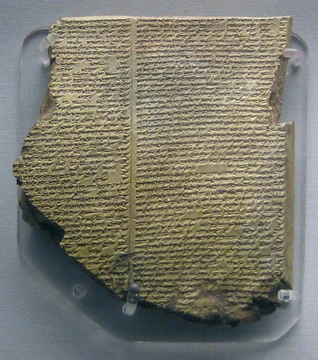
Poetic Edda
Anonymous Old Norse poems preserved in the Codex Regius manuscript.

Wikipedia / Wikimedia Commons
The Poetic Edda is a modern label for a collection of Old Norse narrative poems, all anonymous and written in alliterative verse—these are called Eddic poems. It should not be confused with the Prose Edda, though both are essential for understanding Old Norse poetry. Since the Poetic Edda is a compiled work, editors have disagreed on which poems to include, so published editions vary. Still, every version is built around the poems preserved in the medieval Icelandic manuscript known as the Codex Regius. This manuscript, and by extension the Poetic Edda, is also called the Elder Edda or Sæmundar Edda.
The poems use alliterative verse. Most are written in fornyrðislag, or "old story metre," with málaháttr, or "speech form," as a common variant. About a quarter are in ljóðaháttr, or "song form." The language is generally clear and straightforward. Kennings appear, but they are less frequent and simpler than those in typical skaldic poetry.
Like most early poetry, these were minstrel poems, passed down orally for centuries. None are credited to a specific author, though many show strong individual traits and were likely composed by single poets. Scholars have proposed hypothetical authors, but no firm conclusions have been accepted.
Dating the poems has been a long-standing debate. Firm answers are hard to reach. Lines from Eddic poems sometimes show up in works by known poets. For instance, Eyvindr skáldaspillir, active in the late 10th century, includes a couple of lines in his Hákonarmál that also appear in Hávamál. He might have been quoting an existing poem, or Hávamál—or at least that stanza—might be the later work. A handful of historical figures, like Attila, give a rough earliest possible date. The manuscripts themselves provide a latest possible date. Individual poems also offer clues. Atlamál hin groenlenzku claims in its title to have been composed in Greenland, and some internal evidence supports this. If so, it must date from after about 985, since Scandinavians only reached Greenland then. More reliable than such circumstantial evidence are linguistic dating criteria, drawn from skaldic poems with firmer dates. For example, the particle of, related to ga- or ge- in other old Germanic languages, appears more often in earlier skaldic poems. Applying this to Eddic poetry, Bjarne Fidjestøl found wide variation, suggesting some poems are much older
- field
- Old Norse poetry and mythology
- known_for
- Primary source of Norse mythological and heroic poems
- manuscript
- Codex Regius (13th century)
- also_called
- Elder Edda or Sæmundar Edda
- poetic_forms
- fornyrðislag, málaháttr, ljóðaháttr
Lore & Background
The Eddic poems are composed in alliterative verse, most in fornyrðislag ('old story metre'), with málaháttr as a common variation, and about a quarter in ljóðaháttr ('song form'). The language is usually clear and relatively unadorned; kennings are employed but less frequently and less complexly than in typical skaldic poetry. None of the poems are attributed to a particular author, though many show strong individual characteristics and are likely the work of individual poets; scholars have speculated on hypothetical authors but firm conclusions have never been reached.
Accurate dating of the poems has long been debated. Lines from Eddic poems sometimes appear in poems by known poets, such as Eyvindr skáldaspillir in the latter half of the 10th century, who uses lines also found in Hávamál. The handful of demonstrably historical characters mentioned, such as Attila, provide a terminus post quem. Linguistic dating criteria, such as the occurrence of the particle of and alliteration of vr- with v-, indicate that some poems are much older than others. The problem of dating is linked to determining where they were composed; Iceland was not settled until approximately 870, so earlier poems would have been composed elsewhere, likely in Scandinavia, while more recent poems are likely Icelandic.
Reader's Guide
The Codex Regius, containing 31 poems, is arguably the most important extant source on Norse mythology and Germanic heroic legends. Since the early 19th century, it has had a powerful influence on Scandinavian literature, not only through its stories but also through the visionary force and dramatic quality of many poems. It has inspired later innovations in poetic meter, particularly in Nordic languages, with its use of terse, stress-based metrical schemes that lack final rhymes, focusing instead on alliterative devices and strongly concentrated imagery. Poets who have acknowledged their debt to the Codex Regius include Vilhelm Ekelund, August Strindberg, J. R. R. Tolkien, Ezra Pound, Jorge Luis Borges, and Karin Boye. The manuscript was written during the 13th century, unknown until 1643 when it came into the possession of Bishop Brynjólfur Sveinsson, who attributed it to Sæmundr the Learned—a modern scholars reject. It was sent as a present to the Danish king, stored for centuries in the Royal Library in Copenhagen, and returned to Iceland in 1971 by ship with a naval escort.
Did You Know?
- The Codex Regius was written during the 13th century but was unknown until 1643.
- Bishop Brynjólfur Sveinsson attributed the manuscript to Sæmundr the Learned, a 12th-century Icelandic priest, though modern scholars reject that attribution.
- The Codex Regius was returned to Iceland in 1971, transported by ship with a naval escort because air travel was not considered trustworthy for such precious cargo.
- Poems similar to those in the Codex Regius are also found in manuscripts such as AM 748 I 4to, Hauksbók, and Flateyjarbók.
More in Epic Poetry & Myth 1-20
Spotted an error? Know more?
This is a living reference — every entry is fact-audited, and reader corrections feed straight into our audit queue. Suggest an edit · See this site's audit record