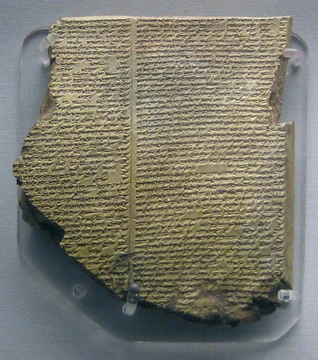
Secret History of the Mongols
Oldest surviving literary work in the Mongolic languages.

Wikipedia / Wikimedia Commons
The oldest surviving work in any Mongolic language, *The Secret History of the Mongols* was composed for the Mongol royal family after Genghis Khan’s death in 1227. It covers his life and conquests, along with part of the reign of his son and successor, Ögedei Khan. The author is unknown and wrote in Middle Mongol using the Mongolian script. The text’s exact date is uncertain, but its colophon states it was finished in the Year of the Mouse at Khodoe Aral on the banks of the Kherlen River, with the earliest possible year being 1228.
Although portions of the *Secret History* were preserved in later chronicles like the *Jami' al-tawarikh*, *Shengwu qinzheng lu*, and *Altan Tobchi*, the full Mongolian text survived only through a version made around the 15th century, early in the Ming dynasty. In that version, the pronunciation was transcribed into Chinese characters to help interpreters, under the title *The Secret History of the Yuan Dynasty*. About two-thirds of the work also appear in slightly different form in the 17th-century Mongolian chronicle *Altan Tobchi* (the “Golden Chronicle”) by Lubsang-Danzin.
The *Secret History* is considered the most important native Mongol account of Genghis Khan. Linguistically, it is the richest source of pre-Classical and Middle Mongol. It is regarded as a classic in both Mongolia and worldwide, and has been translated into more than 40 languages.
The text opens with a semi-mythical genealogy of Genghis Khan, born Temüjin. Legend tells that a blue-grey wolf and a fallow doe produced the first Mongol, Batachiqan. Eleven generations later, a widow named Alan Gua, abandoned by her in-laws with her two sons, bore three more sons fathered by a supernatural glowing man who entered through the smoke-hole of her ger. The youngest of these three divinely conceived children was Bodonchar, founder of the Borjigin clan. The account of Temüjin’s life begins with the kidnapping of his mother, Hoelun, by his father Yesügei. It then follows Temüjin from his birth around 1160, through the hardships after his father’s murder, and the many conflicts, wars, and plots he faced before earning the title Genghis Khan in 1206. The later parts cover the campaigns of Genghis and his third son Ögedei across Eurasia, ending with Ögedei’s reflections on his successes and failures.
Scholars of Mongolian history value the text for its rich informati
- Date of completion
- Uncertain; colophon gives Year of the Mouse, earliest possible 1228; also conjectured as 1229, 1240, 1252, or 1264
- Language
- Middle Mongol
- Script
- Mongolian script
- Author
- Unknown
- Subject
- Life and conquests of Genghis Khan and reign of Ögedei Khan
- Surviving version
- 15th-century Ming dynasty transcription into Chinese characters
- Translations
- Over 40 languages
Lore & Background
The work begins with a semi-mythical genealogy of Genghis Khan, born Temüjin. According to legend, a blue-grey wolf and a fallow doe begat the first Mongol, named Batachiqan. Eleven generations later, a widow named Alan Gua bore three sons with a supernatural glowing man; the youngest, Bodonchar, founded the Borjigin. The description of Temüjin's life starts with the kidnapping of his mother, Hoelun, by his father Yesügei, then covers his early life after his birth around 1160, the difficult times after his father's murder, and the conflicts before he gains the title of Genghis Khan in 1206. The latter parts deal with the campaigns of Genghis and his third son Ögedei throughout Eurasia, ending with Ögedei's reflections on his reign.
Reader's Guide
The Secret History of the Mongols is regarded as the single most significant native Mongol account of Genghis Khan. Linguistically, it provides the richest source of pre-Classical Mongol and Middle Mongol, and is considered unique among Mongol texts as an example free from the influence of Buddhism prevalent in later texts. Scholars value it for its vivid and realistic depictions of daily tribal life and organization of Mongol civilization in the 12th and 13th centuries, complementing Persian and Chinese sources. Its historical accuracy is controversial: some experts assess it positively, while others believe its value lies primarily in its faithful description of Mongol tribal life, and one scholar considered its historical value almost nil. The text was preserved in part as the basis for chronicles such as the Jami' al-tawarikh, Shengwu qinzheng lu, and Altan Tobchi. The full Mongolian body only survived from a version made around the 15th century at the start of the Ming dynasty, where pronunciation was transcribed into Chinese characters under the title The Secret History of the Yuan Dynasty. In 2004, the Government of Mongolia decreed that a copy covered with golden plates be placed in the Government Palace in Ulaanbaatar.
Did You Know?
- The colophon states the book was finished in the Year of the Mouse on the banks of the Kherlen River at Khodoe Aral, corresponding to an earliest possible figure of 1228.
- About two-thirds of the Secret History appear in the 17th-century Mongolian chronicle Altan Tobchi by Lubsang-Danzin.
- The Ming-era text was compiled at the Hanlin Academy as an aid to help interpreters learn Mongolian.
- The oldest dated full copy is a 12-part version from 1805 by Gu Guangqi, kept in the National Library of China.
More in Epic Poetry & Myth 1-20
Spotted an error? Know more?
This is a living reference — every entry is fact-audited, and reader corrections feed straight into our audit queue. Suggest an edit · See this site's audit record